Guides
How to Choose a Pillow
Quick answer
Match a pillow's loft, the compressed height it holds under your head, to your sleeping position: stomach 2 to 3 inches, back 3 to 5, side 5 to 7, and combination 4 to 6. This is widely repeated guidance, not a measurement or a medical recommendation, so use it as a starting range and adjust from there.
Pillow shopping tends to focus on fill material, cooling claims, and firmness labels, when the single number that actually predicts whether a pillow feels right is loft. Loft is not how thick the pillow looks sitting on the shelf, it is how tall it stays once your head is actually pressing into it, and matching that compressed height to how you sleep does more for comfort than almost anything else on the label. This is general information about support and preference, not medical advice, and it treats no condition.
On this page
What does loft actually mean on a pillow?
Loft is the pillow's compressed height under the weight of your head, not its uncompressed shelf height. A pillow that looks tall and fluffy in the package can compress down to a very different number once you are lying on it, which is why the shelf height printed on packaging is a poor guide by itself. The compressed loft is what actually keeps your neck in a neutral position relative to your spine, and it changes depending on how you sleep.
What loft fits each sleeping position?
| Position | Loft (compressed) | Why |
|---|---|---|
| Stomach | 2 to 3 in | A low loft keeps the neck from craning upward. |
| Back | 3 to 5 in | A moderate loft fills the curve behind the neck without pushing the head forward. |
| Side | 5 to 7 in | The pillow has to fill the full gap between the ear and the shoulder. |
| Combination | 4 to 6 in | A middle loft that works reasonably across positions during the night. |
Convention, not a standard
This is widely repeated guidance rather than a measured standard. Treat it as a starting point.
These ranges are widely repeated guidance across the bedding category, not a measured standard, and they are not a treatment for neck pain or any other condition. Broader shoulders on a side sleeper generally call for the higher end of that range. Check your own numbers with Pillow Loft Calculator.
Should I get a fixed loft or an adjustable one?
An adjustable loft pillow, typically filled with shredded memory foam, lets you add or remove fill to move loft up or down without buying a second pillow, which is genuinely useful if you are not sure where you land in the range above, sleep in more than one position, or share a bed with someone whose loft needs differ from yours. A fixed loft pillow is simpler and often cheaper once you already know the number that works, since there is nothing left to adjust.
Does fill material change which loft I should buy?
Fill material affects how a pillow holds its loft over the night more than it changes which loft number to start from. Solid memory foam keeps a fairly constant compressed height once you settle into it, while shredded memory foam compresses a little more under sustained weight and can be redistributed by hand to raise or lower loft in specific spots, such as under the neck. Either fill can be built to any of the loft ranges above, so pick loft first based on sleeping position, then choose the fill that matches how much you want the pillow to hold its shape through the night.
A note on pillows and neck or shoulder discomfort
Pillows worth a look by loft need

Coop Home Goods Original Adjustable Pillow
$89.00Queen adjustable loft pillow with memory foam fill, so loft can be tuned rather than replaced when it feels wrong.
Check price on Amazon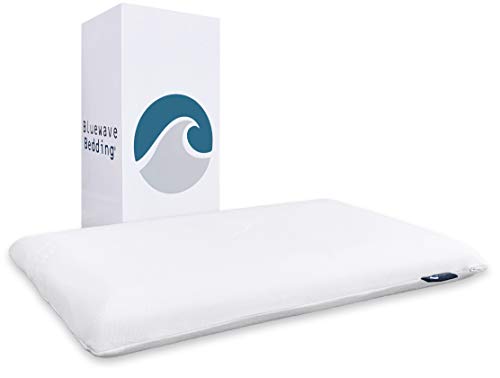
Bluewave Bedding Ultra Slim Gel Memory Foam Pillow for Stomach and Back Sleepe
$39.95Ultra slim gel memory foam pillow described by the maker for stomach and back sleepers, matching the lower loft that position calls for.
Check price on Amazon
Olive + Crate Adjustable Loft Shredded Memory Foam Pillow - Queen Size
$59.98Queen adjustable loft pillow with memory foam fill, a second option for tuning loft toward the middle of the range.
Check price on Amazon
Royal Therapy Memory Foam Pillow
$59.99Queen memory foam pillow at a fixed loft, a straightforward option once your position and loft range are known.
Check price on AmazonFrequently asked questions
How do I choose the right pillow loft?
Match loft, the compressed height under your head, to how you sleep: roughly 2 to 3 inches for stomach sleepers, 3 to 5 for back sleepers, 5 to 7 for side sleepers, and 4 to 6 for combination sleepers. These are widely repeated ranges rather than a measured standard, so treat them as a starting point and adjust from there based on comfort.
Is pillow loft the same as pillow thickness on the shelf?
No. Shelf thickness is how tall the pillow looks uncompressed in the package. Loft is how tall it stays once your head is actually resting on it, which is usually a smaller number. A pillow that looks very thick on a shelf can compress down to a moderate loft under real weight, so judge it by feel rather than by its packaged height.
What loft is best for side sleepers?
Commonly 5 to 7 inches of compressed loft, because a side sleeper's pillow has to fill the entire gap between the ear and the shoulder to keep the neck level with the spine. Broader shoulders generally need the higher end of that range. This is general guidance rather than a measurement, so use it as a starting point.
Should I buy an adjustable loft pillow?
It is a reasonable choice if you are unsure which loft suits you, sleep in more than one position through the night, or share a bed with someone whose needs differ. An adjustable pillow lets you add or remove fill to change loft without buying a new pillow. A fixed loft pillow works fine once you already know the number you want.
Can a pillow fix neck pain?
A pillow matched to your sleeping position can support a more neutral neck position, but this is comfort guidance, not a medical treatment, and it does not diagnose or cure anything. Ongoing or severe neck or shoulder discomfort is a question for a medical professional rather than something to solve through pillow shopping alone.
Does pillow firmness matter as much as loft?
Loft generally has a bigger effect on neck alignment, since it decides how much gap the pillow actually fills. Firmness is more about surface feel and preference on top of that loft. Both matter, but if you can only get one right, matching loft to your sleeping position is the more consequential choice of the two.
How to read the numbers on this page. Standard mattress and bedding dimensions are industry-wide and the same across manufacturers. Guidance like replacement intervals, firmness by body weight and walking clearance is convention rather than a measured standard, and every table here says which it is. Where a manufacturer does not publish a figure we leave it out instead of estimating. This is not medical advice: a mattress is not a treatment for a medical condition, and persistent pain is a reason to see a clinician.