Guides
How to Measure a Bedroom for a Bed
Quick answer
The bed's real footprint is the mattress size plus roughly 2 to 4 inches of frame rail per side and 2 to 4 inches of headboard length, not the mattress size alone. Compare that footprint against the room and leave at least 24 inches on the tightest side, 30 inches for comfortable walking, and 36 inches on the room's main walkway.
Most bedroom measuring mistakes happen because the mattress size gets compared straight against the room, and the frame and headboard never enter the math. A queen mattress is 60 by 80 inches, but a queen bed with a frame and headboard against the wall commonly occupies closer to 65 by 84 inches once the rails and headboard are counted. That difference is exactly the width of a nightstand drawer that will not open, so it is worth getting right before anything ships.
On this page
What actually has to fit in the room?
Three things stack together to make the bed's real footprint: the mattress itself, the frame's rails around it, and a headboard if the bed has one. The mattress size is fixed and standardised. The frame and headboard are not, they add a few inches on top of the mattress that vary by model, and that added margin is the part people forget to measure. A bed that "fits" only when compared mattress-to-room will often not fit once the actual frame is sitting in the room.
Standard mattress sizes to start from
| Size | Width (in) | Length (in) |
|---|---|---|
| Twin | 38 | 75 |
| Twin XL | 38 | 80 |
| Full | 54 | 75 |
| Queen | 60 | 80 |
| King | 76 | 80 |
| California King | 72 | 84 |
Industry standard
These are standard published dimensions, the same across manufacturers.
These six are industry-standard US sizes built to the same footprint by every manufacturer. This is the starting number for the room calculation, not the finished one, since the frame and any headboard add to it. Check the full breakdown with the size chart.
How much clearance do you actually need around the bed?
| Clearance | Distance | What it feels like |
|---|---|---|
| Tight | 24 in | You can pass, but turn sideways at a nightstand. |
| Comfortable | 30 in | Normal walking room on the side you use most. |
| Main walkway | 36 in | A path through the room, not just beside the bed. |
Convention, not a standard
This is widely repeated guidance rather than a measured standard. Treat it as a starting point.
These figures are a widely repeated convention for bedroom layout, not a building code or a measured standard. Use 24 inches as the absolute floor and 30 to 36 inches wherever the room allows it, especially on the side someone actually gets in and out on.
How to measure a bedroom for a bed, step by step
- Measure the room, not just the wall. Get the room's usable width and length, working around any door swing, closet doors, or radiators that eat into the floor space before the bed does.
- Add frame overhang to the mattress size. A frame's rails typically add about 2 to 4 inches of width and length per side beyond the bare mattress. Add that to the standard size to get the frame's outer footprint.
- Add headboard length if the frame has one. A headboard commonly adds another 2 to 4 inches to the bed's overall length. Skip this step for a frame with no headboard.
- Subtract the bed footprint from the room. Place the bed against its planned wall and subtract its footprint from the room's width and length. What is left on each side is your real clearance.
- Compare the remainder to the clearance figures. Check the smallest remaining gap against 24, 30, and 36 inches. The tightest side, not the average, determines whether the layout actually works day to day.
- Recheck before buying a bigger size. If the numbers are close, run the room and bed combination again before sizing up, since a few inches of frame or headboard can be the difference between comfortable and cramped.
Frames that keep the footprint small

Yaheetech Queen Size Solid Wood Platform Bed Frame Low-Profile Dark Walnut
$107.99Solid wood platform frame with no headboard listed, keeping the footprint to the rails alone.
Check price on Amazon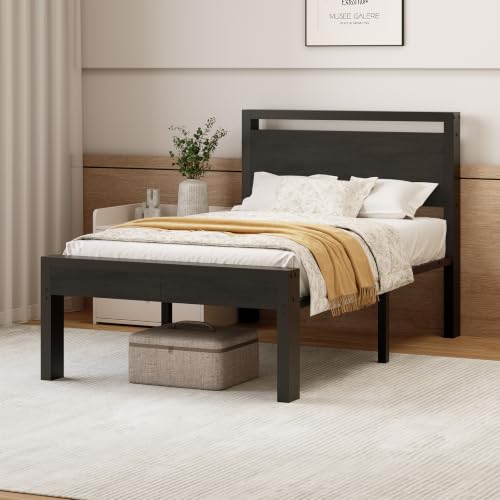
Sweetcrispy 14 Inch Twin Size Metal Bed Frame with Wood Headboard
$69.98Twin steel frame, 14 inch deck height, with a wood headboard included for a small room that still wants one.
Check price on Amazon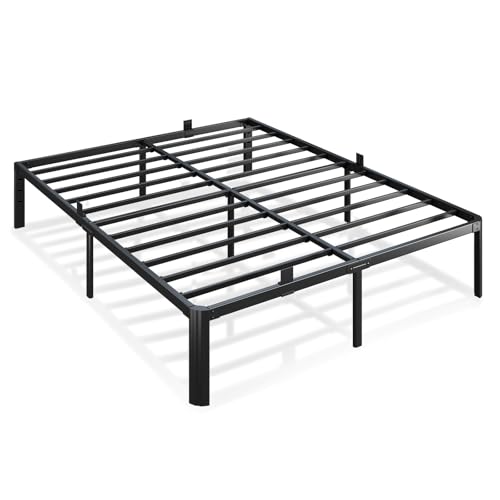
Metal Bed Frame King Size
$89.97King steel frame, 14 inch deck height, with no headboard adding to the footprint.
Check price on Amazon
Mellow Naturalista Grand - 12 Inch Solid Wood Platform Bed with Wooden Slats -
$203.08Queen solid wood platform frame, 12 inch deck height, built with no box spring needed.
Check price on AmazonFrequently asked questions
How do I measure a bedroom for a bed?
Measure the room's usable width and length first, working around door swing and closets. Add roughly 2 to 4 inches per side for the frame's rails and, if there is one, 2 to 4 inches of length for a headboard, on top of the mattress's standard size. Subtract that total footprint from the room and check what remains against typical walking clearance figures before choosing a size.
Is mattress size the same as bed footprint?
No. Mattress size is a fixed, standardised width and length, but the finished bed is larger once a frame and headboard are added. A frame typically adds about 2 to 4 inches per side beyond the mattress, and a headboard adds roughly 2 to 4 inches more to the total length, so always measure the room against the frame's footprint, not the bare mattress.
How much space should be left around a bed?
A commonly used convention is 24 inches as a tight but usable minimum, 30 inches for comfortable everyday walking, and 36 inches for a room's main walkway. These are widely repeated guidelines rather than a measured standard, so treat 24 inches as the floor and aim higher on the side of the bed that gets used most for getting in and out.
What size bed fits a small bedroom?
It depends on the room's actual clearance once a frame's footprint is subtracted, not on a fixed room size rule. A twin or full fits most smaller rooms with room to spare, while a queen needs roughly 65 by 84 inches of floor space including frame overhang and headboard, so measure your specific room rather than assuming a size works.
Does a headboard change how much room I need?
Yes, it adds to the bed's total length, commonly another 2 to 4 inches beyond what the frame's rails already add to the mattress. That is on top of, not instead of, the frame overhang, so a bed with both a frame and a headboard needs more length than either addition measured alone.
Should I measure before or after choosing a frame?
Before, using a frame overhang estimate, and then again once you have picked one. A rough estimate of 2 to 4 inches per side is close enough to decide on a mattress size, but the exact frame you choose can vary within that range, so confirm the room fit against the specific frame's stated dimensions before it ships.
How to read the numbers on this page. Standard mattress and bedding dimensions are industry-wide and the same across manufacturers. Guidance like replacement intervals, firmness by body weight and walking clearance is convention rather than a measured standard, and every table here says which it is. Where a manufacturer does not publish a figure we leave it out instead of estimating. This is not medical advice: a mattress is not a treatment for a medical condition, and persistent pain is a reason to see a clinician.