Guides
How to Measure a Mattress
Quick answer
Measure a mattress in three places: width, length and depth (thickness), all in inches, with the bare mattress and nothing stacked on it. Compare the result to the standard US sizes to identify what you actually have, since two mattresses can share a size name and still differ in thickness.
Measuring a mattress sounds trivial until you actually need the number for something, buying sheets, checking a frame, or working out whether it will fit through a stairwell, and then the small details start to matter: where exactly to put the tape, whether to include a topper, and what "depth" even means on a mattress with no obvious edge. Here is the version that holds up under those uses.
On this page
What three measurements do you actually need?
Width and length describe the footprint, the same two numbers printed on every size chart. Depth, also called thickness, is the vertical measurement from the top seam down to the bottom of the mattress, and it is the number that decides sheet pocket depth and how a mattress is classified as low profile, standard, deep, or extra deep. All three should be measured on the bare mattress, with any topper or protector removed, because those layers change what fitted sheets and frames actually have to clear and need to be accounted for separately rather than folded into the mattress's own number.
Standard mattress sizes to check your result against
| Size | Width (in) | Length (in) |
|---|---|---|
| Twin | 38 | 75 |
| Twin XL | 38 | 80 |
| Full | 54 | 75 |
| Queen | 60 | 80 |
| King | 76 | 80 |
| California King | 72 | 84 |
Industry standard
These are standard published dimensions, the same across manufacturers.
These six are industry-standard US sizes, built to the same footprint by every manufacturer. If your measured width and length are close but not exact, that is normal manufacturing tolerance; if they are off by more than an inch or two, you may have a specialty size such as an Olympic Queen or a Texas King, which are real products but are not standardised and vary between makers.
How to measure it step by step
- Clear the bed. Strip off the sheets, any topper, and any protector so you are measuring the bare mattress. Layers on top inflate the depth number and are better accounted for separately.
- Measure width. Run the tape across the shortest side at the head, the middle, and the foot. Use the smallest of the three readings, since a mattress can bow very slightly along its length.
- Measure length. Run the tape along the long side from the top edge to the bottom edge, checked on both the left and right sides. They should match closely; a real difference points to a warped or damaged mattress.
- Measure depth (thickness). Stand the tape straight down the side, from the top seam to the floor of the frame or box spring underneath. This is the figure thickness classes and sheet pocket depth are both built around.
- Add anything that sits on top, separately. A topper or protector adds its own full thickness to the stack a fitted sheet has to clear. Note it as a separate number rather than folding it into the mattress's own depth measurement.
- Compare to the standard chart. Match your width and length against the standard table above. A close match confirms the size; a real mismatch usually means a specialty size that varies by manufacturer.
What your depth measurement decides for sheets
| Pocket class | Fits mattress depth |
|---|---|
| Standard pocket | up to 12 in |
| Deep pocket | 13 to 17 in |
| Extra deep pocket | 18 to 22 in |
Industry standard
These are standard published dimensions, the same across manufacturers.
Nothing is sold as a standard class above 22 inches. If your measured stack, mattress plus topper plus protector, is deeper than that, look for a sheet that states its own exact pocket depth rather than a class name, or use sheet straps. Check your own stack with Sheet Pocket Depth Calculator.
Thickness classes as manufacturers label them
| Class | Thickness |
|---|---|
| Low profile | 6 to 8 in |
| Standard | 9 to 12 in |
| Deep / thick | 13 to 15 in |
| Extra deep | 16 to 24 in |
Industry standard
These are standard published dimensions, the same across manufacturers.
These are the labels manufacturers use consistently across listings, built directly from the depth number you just measured.
Sheets and protectors sized for a deep measurement

Hearth & Harbor Extra Deep Pocket Queen Sheets Sets - Fits Mattress 18-24 Inch
$26.99Queen sheet set of 6, a stated pocket depth of 18 to 24 inches.
Check price on Amazon
Extra Deep Pocket Queen Fitted Sheet
$13.70Queen fitted sheet, a stated pocket depth of 16 to 21 inches.
Check price on Amazon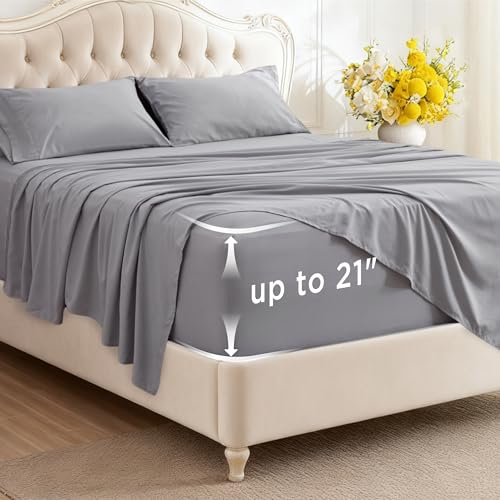
Bedsure Deep Pocket Queen Sheets Set - Fits Mattresses Up to 21 Inches Thick -
$24.99Queen sheet set of 4, a stated pocket depth of up to 21 inches.
Check price on Amazon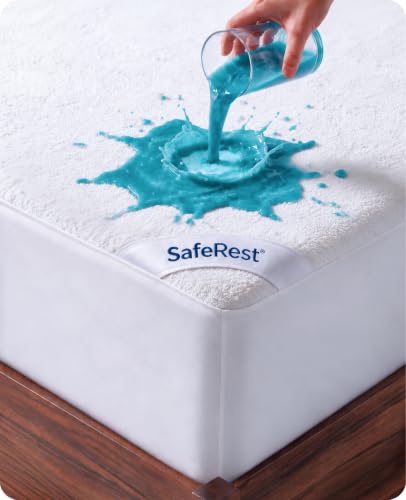
SafeRest Waterproof Queen Size Mattress Protector
$39.99Queen waterproof mattress protector, adds minimal thickness to the stack compared to a topper.
Check price on AmazonFrequently asked questions
How do I measure a mattress correctly?
Strip the bed to the bare mattress, then measure width across the shortest side at three points, length along the long side on both edges, and depth straight down from the top seam to the floor. Use the smallest width and an average length if the readings vary slightly. Compare the result to the standard size chart to confirm what size you actually have.
Do I measure a mattress with the topper on or off?
Off, for the mattress's own depth. A topper adds its full thickness on top of the mattress and should be measured and tracked separately, since it changes what a fitted sheet needs to clear but does not change the mattress's own thickness class or size classification.
What is mattress depth exactly?
Depth, also called thickness, is the vertical distance from the top seam of the mattress down to its bottom, measured straight down the side. It is separate from width and length, which describe the footprint. Depth is the number that determines both a mattress's published thickness class and the fitted sheet pocket depth it needs.
Why don't my mattress's measurements match the size label exactly?
Small differences of a half inch or so are normal manufacturing tolerance on an otherwise standard size. Differences of more than an inch or two more likely mean you have a specialty size, such as an Olympic Queen or a Texas King, which are real products sold under those names but are not standardised, so exact dimensions vary between manufacturers.
What sheet pocket depth do I need for my measured mattress?
Add your measured mattress depth to the thickness of any topper or protector you use, then match the total against the published classes: standard pockets fit up to 12 inches, deep pockets 13 to 17 inches, and extra deep pockets 18 to 22 inches. Nothing standard is sold above 22 inches, so look for a sheet stating its own exact depth beyond that.
Does mattress thickness affect the size name (twin, queen, and so on)?
No. The size name refers only to width and length, the footprint. Thickness is a completely separate measurement and can range from about 6 inches to over 16 within the same size name. A thicker mattress changes total bed height and sheet pocket depth, but never changes the standard footprint tied to its size name.
How to read the numbers on this page. Standard mattress and bedding dimensions are industry-wide and the same across manufacturers. Guidance like replacement intervals, firmness by body weight and walking clearance is convention rather than a measured standard, and every table here says which it is. Where a manufacturer does not publish a figure we leave it out instead of estimating. This is not medical advice: a mattress is not a treatment for a medical condition, and persistent pain is a reason to see a clinician.