Comparisons
Memory Foam vs Latex
Quick answer
Memory foam wins on price and availability, and it is the right default for most shoppers. Memory foam commonly lasts 8 to 10 years against latex's 10 to 15, and latex sleeps cooler thanks to its naturally open cell structure, but latex costs significantly more per inch and is heavy enough that moving or rotating one alone is a real chore. Skip latex if you are budget-constrained, move often, or cannot get help lifting a heavy mattress. Consider latex instead if you plan to keep the same mattress for over a decade and sleep hot enough that cooling is worth paying for.
Memory foam and latex are both foam constructions, but they come from different materials with genuinely different feel, temperature and lifespan characteristics. Memory foam is a petroleum-derived viscoelastic foam that softens with body heat and slowly recovers its shape. Latex, when genuinely natural, is derived from the sap of the rubber tree, and it behaves almost the opposite way: it responds instantly, pushes back rather than sinking in, and stays more consistent in temperature because its open cell structure lets air move through it. This catalog currently carries memory foam as complete mattresses in every standard size, while its real latex product is a natural latex topper rather than a full latex mattress, which shapes how the buying advice below is framed.
On this page
What is actually different between memory foam and latex?
Cut a memory foam mattress open and you find a soft, dense foam that slowly conforms around pressure and slowly releases it, the classic slow-motion sink-and-recover feel. Natural latex is manufacturer-described as a springier, faster-responding material: it contours less deeply, pushes back sooner, and its more open cellular structure allows air to move through it rather than trapping heat the way a solid foam block can. That structural difference is the reason for almost every practical difference between the two.
The catalog behind this site does not currently carry a complete latex mattress in any size; the latex products available are natural latex toppers, sold in 2 and 3 inch thicknesses. That makes this comparison slightly different from the others on this site: the honest way to frame it is memory foam as a complete mattress against latex as a material you can add to any mattress you already own, or use to test the feel before shopping for a full latex mattress elsewhere.
How do memory foam and latex actually compare?
| Factor | Memory foam | Latex |
|---|---|---|
| Feel and recovery | Slow, deep contour, a "sinking in" feel. | Faster response, pushes back rather than sinking deeply. |
| Sleeps cool | Weaker point unless a cooling layer is added. | Stronger, thanks to latex's naturally open cell structure. |
| Typical lifespan | 8 to 10 years. | 10 to 15 years. |
| Weight | Lighter, easier for one person to move or rotate. | Noticeably heavier per inch; a full latex mattress commonly needs two people to move. |
| Cost in this catalog | From $264.03 for a complete queen mattress. | A 2 to 3 inch natural latex topper runs $219.00 to $329.00, several times the per-inch cost of the memory foam mattress. |
| Available as a complete mattress in this catalog | Yes, every standard size. | No; available only as a topper here. |
Convention, not a standard
This is widely repeated guidance rather than a measured standard. Treat it as a starting point.
Who should actually pick each one, and who should skip latex entirely?
Pick memory foam if budget is a real constraint, you want the widest possible selection of sizes and price points, you move apartments or rearrange bedrooms often and want a lighter mattress to handle alone, or you simply have not decided whether latex's firmer, springier feel suits you yet.
Consider latex if you sleep hot and cooling is worth paying a real premium for, you plan to keep the same mattress well past the 8 to 10 year window memory foam typically lasts, and you do not mind that a complete latex mattress costs noticeably more and weighs enough that moving it is a two-person job.
Skip latex if any of those weigh against you: a tight budget, frequent moves, renting without help to lift heavy furniture, or simply not knowing yet whether the firmer, more buoyant latex feel suits how you sleep. A latex topper on a mattress you already own is the lower-risk way to test that feel before committing to a full latex mattress purchase elsewhere.
Which memory foam mattress and latex product should you actually buy?

Novilla Queen Size Mattress
$264.03A 14 inch queen memory foam mattress with a manufacturer-described cooling feature, at $264.03, available as a complete mattress in every standard size.
Check price on Amazon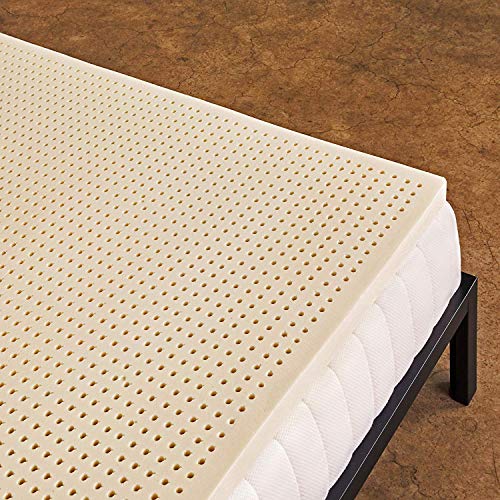
Pure Green Natural Latex Mattress Topper - Medium Firmness - 2 Inch - Queen Si
$219.00A 2 inch natural latex topper in a medium feel, at $219.00. This catalog's real latex product is a topper rather than a complete mattress, and it is the practical way to add genuine latex feel and cooling to a mattress you already own, or to test the material before buying a full latex mattress elsewhere.
Check price on AmazonHow do these two specific products compare on paper?
| Spec | Novilla Queen Size Mattress | Pure Green Natural Latex Mattress Topper - Medium Firmness - 2 Inch - Queen Si |
|---|---|---|
| Price | $264.03 | $219.00 |
| Size | Queen | Queen |
| Thickness | 14 in | 2 in |
| Construction | Memory foam | - |
| Feel | - | Medium |
| Cooling | Manufacturer describes a cooling feature | - |
| Material | - | Natural latex |
A dash means the manufacturer does not publish that figure for this product. We do not estimate it.
Frequently asked questions
Does latex sleep cooler than memory foam?
Generally, yes. Natural latex has a more open cell structure than solid memory foam, which lets air move through it rather than trapping body heat the way a dense foam block can. A memory foam mattress with a manufacturer-described cooling layer narrows the gap but rarely closes it entirely, since the core foam underneath that layer is still solid.
Is a latex mattress more durable than memory foam?
As a general rule, yes. Latex commonly lasts 10 to 15 years before comfort loss becomes noticeable, against memory foam's commonly cited 8 to 10 years. Both figures are industry conventions rather than a guarantee tied to any specific product, and a visible body impression or a soft spot are the real signal to replace either type, not the calendar alone.
Why is latex so much more expensive than memory foam?
Natural latex is a more costly raw material to produce than the petroleum-derived foam used in memory foam mattresses, and that cost carries through to the finished product. In this catalog, a 2 to 3 inch natural latex topper alone costs several times more per inch than a complete memory foam mattress, which shows just how large that material cost gap actually is.
Is a natural latex topper the same as a latex mattress?
No. A topper is a thin layer, commonly 2 to 3 inches, placed on top of an existing mattress to change surface feel; it does not replace the mattress's core support structure. A complete latex mattress uses latex through some or all of its build and replaces the mattress entirely. A topper is a lower-cost way to test latex's feel before buying a full latex mattress.
Who should not buy a latex mattress?
Anyone on a tight budget, since latex costs significantly more per inch than memory foam. Anyone who moves frequently or cannot get help lifting heavy furniture should also be cautious, since a complete latex mattress is noticeably heavier than a comparable memory foam mattress and commonly needs two people to move or rotate.
How to read the numbers on this page. Standard mattress and bedding dimensions are industry-wide and the same across manufacturers. Guidance like replacement intervals, firmness by body weight and walking clearance is convention rather than a measured standard, and every table here says which it is. Where a manufacturer does not publish a figure we leave it out instead of estimating. This is not medical advice: a mattress is not a treatment for a medical condition, and persistent pain is a reason to see a clinician.