Size charts
Mattress Thickness Chart
Quick answer
Standard mattress thickness classes: low profile 6 to 8 in, standard 9 to 12 in, deep/thick 13 to 15 in, extra deep 16 to 24 in. Thickness alone does not decide quality: it decides which foundation, sheets and frame clearance work with the mattress.
Mattress thickness is marketed as a comfort feature, but its practical effect is on everything around the mattress: which sheets fit, how tall the finished bed sits, and whether a frame's clearance still works once the mattress is in place. The four classes below are how manufacturers themselves group thickness, and the second table shows where the thicknesses actually sold most often land inside them.
Standard mattress thickness classes
| Class | Thickness range (in) |
|---|---|
| Low profile | 6 to 8 |
| Standard | 9 to 12 |
| Deep / thick | 13 to 15 |
| Extra deep | 16 to 24 |
Industry standard
These are standard published dimensions, the same across manufacturers.
Where common mattress thicknesses fall
| Thickness (in) | Class |
|---|---|
| 8 | Low profile |
| 9 | Standard |
| 10 | Standard |
| 12 | Standard |
| 14 | Deep / thick |
| 16 | Extra deep |
Industry standard
These are standard published dimensions, the same across manufacturers.
12 inch mattresses are the single most common thickness sold across memory foam and hybrid construction, sitting at the top edge of the standard class.
Why thickness matters beyond feel
A thicker mattress is not automatically a better one, and thickness by itself says nothing about firmness, since a firm 8 inch mattress and a soft 14 inch mattress both exist. What thickness reliably changes is what has to fit around the mattress: check the sheet pocket depth chart before buying sheets for anything 13 inches or thicker, check the bed frame dimensions chart for frame and clearance implications, and run your exact stack through Total Bed Height Calculator before deciding a deep mattress plus a tall foundation will still feel comfortable to climb into.
Shop mattresses across the thickness range

EGOHOME 8 Inch Twin Mattress
$109.998 inch twin memory foam, medium firm feel as the maker describes it.
Check price on Amazon
Zinus Memory Foam 10 Inch Green Tea Mattress
$229.9910 inch queen memory foam.
Check price on Amazon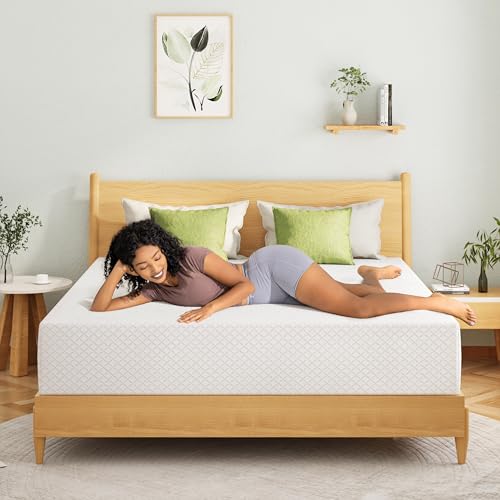
EGOHOME Queen Mattress 12 Inch
$249.9912 inch queen memory foam, medium firm feel as the maker describes it.
Check price on Amazon
Novilla Bliss Mattress Queen Size
$339.9914 inch queen memory foam.
Check price on Amazon
16 Inch King Size Mattress
$379.9916 inch king hybrid, medium firm feel as the maker describes it.
Check price on AmazonFrequently asked questions
What mattress thickness is considered standard?
A standard mattress runs 9 to 12 inches thick, and 12 inches specifically is the most commonly sold single thickness across both memory foam and hybrid construction. Below that, 6 to 8 inches is classed as low profile, often used for bunk beds, daybeds or guest rooms. Above 12 inches, 13 to 15 is deep or thick, and 16 inches and up is extra deep.
Is a thicker mattress always better?
No. Thickness describes how tall the mattress is, not how firm, supportive or durable it is. A firm mattress can be built at 8 inches and a soft one at 14 inches. What a thicker mattress does reliably change is what has to fit around it: sheets need a deeper pocket, total bed height climbs, and the mattress itself weighs more, which matters when moving it or checking frame capacity.
What counts as a low profile mattress?
Low profile mattresses run 6 to 8 inches thick, noticeably thinner than the 9 to 12 inch standard class. They are commonly chosen for bunk beds, daybeds, trundle beds, RVs and guest rooms where keeping total height down matters more than maximum cushioning. A low profile mattress still fits standard-width and length sheets; it is only the pocket depth that differs.
Does mattress thickness affect what sheets fit?
Yes, directly, but not by itself: it is the mattress thickness plus any topper and protector combined that decides pocket depth. A 12 inch mattress alone still fits a standard pocket sheet, rated up to 12 inches, but a 14 inch mattress needs a deep pocket sheet, rated 13 to 17 inches, and anything past 22 inches of combined stack has no standard sheet size at all.
What thickness is best for a bunk bed or daybed?
Low profile mattresses, 6 to 8 inches thick, are the usual choice for bunk beds and daybeds, since these frames typically have guardrails or side rails set to a specific height, and a thicker mattress can raise the sleeping surface above the rail's safe clearance. Always check the specific bunk or daybed frame's maximum mattress thickness before buying, since rail heights vary between manufacturers.
How thick are most hybrid mattresses?
Hybrid mattresses in this catalog most commonly run 12 to 14 inches, landing in the standard to deep/thick classes, since a hybrid needs room for both a coil support layer and one or more foam comfort layers. Thinner 10 inch hybrids and thicker 16 inch hybrids both exist, but 12 and 14 inches are the two most frequently sold thicknesses for this construction type.
How to read the numbers on this page. Standard mattress and bedding dimensions are industry-wide and the same across manufacturers. Guidance like replacement intervals, firmness by body weight and walking clearance is convention rather than a measured standard, and every table here says which it is. Where a manufacturer does not publish a figure we leave it out instead of estimating. This is not medical advice: a mattress is not a treatment for a medical condition, and persistent pain is a reason to see a clinician.