Size charts
Room Size Needed for Each Bed Size
Quick answer
Minimum comfortable room size (bed footprint plus 30 in of walking clearance on the open sides, headboard against a wall), width by length: Twin about 104 x 111 in, Full about 120 x 111 in, Queen about 126 x 116 in, King about 142 x 116 in, California King about 138 x 120 in. Widely used clearance guidance is 24 in tight, 30 in comfortable, 36 in for a main walkway.
The room size a mattress needs is not the mattress's own dimensions, it is the frame's footprint (mattress plus rail overhang) plus enough clearance to walk around it. This chart adds those two together for every standard size, using a headboard-against-the-wall layout and comfortable clearance on the remaining sides, so you get a room dimension rather than just a bed dimension.
Minimum room size by mattress size, comfortable clearance
| Mattress size | Bed footprint (in) | Room width needed (in) | Room length needed (in) |
|---|---|---|---|
| Twin | 44 x 81 | 104 | 111 |
| Twin XL | 44 x 86 | 104 | 116 |
| Full | 60 x 81 | 120 | 111 |
| Full XL | 60 x 86 | 120 | 116 |
| Queen | 66 x 86 | 126 | 116 |
| King | 82 x 86 | 142 | 116 |
| California King | 78 x 90 | 138 | 120 |
Calculated
These figures are calculated from the numbers shown, not quoted from a manufacturer.
Footprint assumes a 3 in frame overhang per side, the same default used in bed frame dimensions chart. Room width adds 30 in of comfortable clearance on both open long sides; room length adds 30 in at the foot, assuming the headboard sits against a wall with no clearance needed there. Plug in your own room and layout at Room Size and Clearance Calculator.
How clearance tier changes the room a queen bed needs
| Clearance tier | Clearance each side (in) | Room width needed for a queen bed (in) |
|---|---|---|
| Tight | 24 | 114 |
| Comfortable | 30 | 126 |
| Main walkway | 36 | 138 |
Convention, not a standard
This is widely repeated guidance rather than a measured standard. Treat it as a starting point.
These are the widely repeated clearance thresholds, not a building code. Room width here assumes clearance on both open long sides of the bed; a room with only one open side needs less.
The layout assumption behind these numbers
Both tables above assume the headboard sits flush against a wall, so no clearance is needed on that side, and comfortable walking room is left on the two long sides and at the foot. A room laid out differently, such as a bed in a corner with only one open long side, needs less width than shown here but more careful checking of the remaining paths to closets and doors. Enter your own room dimensions and layout at Room Size and Clearance Calculator rather than assuming this default layout matches your bedroom.
Shop frames sized for a smaller footprint

ZINUS Vivek Deluxe Wood Platform Bed Frame with Headboard
$279.00Queen solid wood frame.
Check price on Amazon
Yaheetech Queen Size Solid Wood Platform Bed Frame Low-Profile Dark Walnut
$107.99Queen solid wood frame.
Check price on Amazon
Cozy City Queen Bed Frame
$59.99Queen steel frame, 14 in deck height.
Check price on Amazon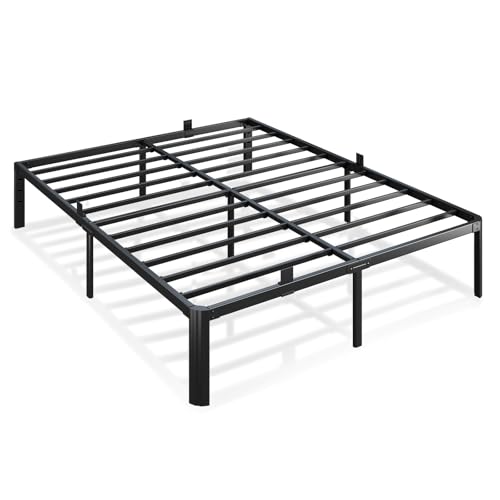
Metal Bed Frame King Size
$89.97King steel frame, 14 in deck height.
Check price on AmazonFrequently asked questions
What is the minimum room size for a queen bed?
Using a queen bed footprint of 66 by 86 inches (mattress plus a 3 inch frame overhang per side) and 30 inches of comfortable clearance on the open sides with the headboard against a wall, the room needs to be roughly 126 by 116 inches, or about 10.5 by 9.7 feet. A smaller room can still work at tighter clearance, closer to 114 inches wide at the 24 inch tight tier.
How much bigger should a bedroom be than the bed?
Widely used clearance guidance adds 24 inches for tight but usable walking space, 30 inches for comfortable clearance, and 36 inches for a main walkway, on top of the bed's own footprint (mattress plus roughly 3 inches of frame overhang per side). These are conventional planning numbers repeated across the industry, not a building code, so treat them as a starting point for your own layout.
Can a king bed fit in a 10 by 10 foot room?
Not comfortably by width. A king bed's footprint is about 82 inches wide, and even at the tightest 24 inch clearance tier on both sides, the room needs about 130 inches (roughly 10.8 feet) of width, more than a 10 foot (120 inch) room provides. A king generally needs an 11 to 12 foot wide room to have any real walking space beside it.
Does the mattress size or the frame footprint decide room size?
The frame footprint, not the bare mattress size, is what actually needs to fit in the room, since the frame's rails and any headboard or footboard add a few inches beyond the mattress on every side, commonly around 3 inches per side for a simple platform frame. Measure the specific frame's outer dimensions rather than just looking up the mattress size when checking room fit.
How much room does a Full bed need?
A Full bed footprint runs about 60 by 81 inches (mattress plus a 3 inch frame overhang per side), and with 30 inches of comfortable clearance on the open sides and the headboard against a wall, the room needs to be roughly 120 by 111 inches, or about 10 by 9.25 feet. Tighter clearance can bring that down, but a main walkway around the bed needs more.
What clearance is enough to walk past a bed?
Widely used guidance puts 24 inches as the minimum to walk past a bed sideways at all, 30 inches as comfortable normal clearance, and 36 inches as the space wanted for a main walkway through the room, such as a path to a closet or door. These figures are conventional planning thresholds repeated across the furniture and design industry, not a formal building code requirement.
How to read the numbers on this page. Standard mattress and bedding dimensions are industry-wide and the same across manufacturers. Guidance like replacement intervals, firmness by body weight and walking clearance is convention rather than a measured standard, and every table here says which it is. Where a manufacturer does not publish a figure we leave it out instead of estimating. This is not medical advice: a mattress is not a treatment for a medical condition, and persistent pain is a reason to see a clinician.